

September 26, 2026
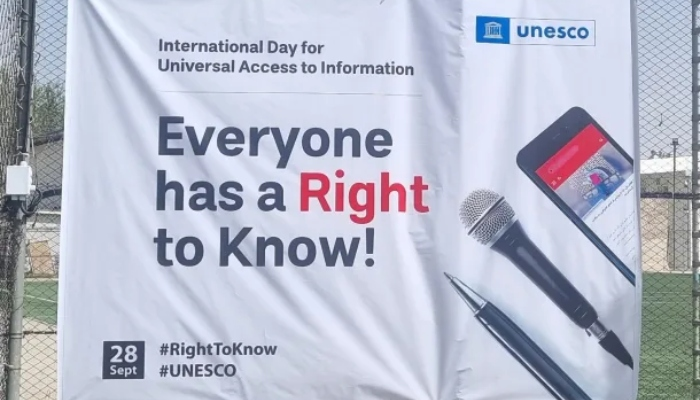
There has never been more information at our fingertips and perhaps also never more uncertainty about what to believe. As the International Day for Universal Access to Information approaches on September 28, its focus on timely and credible public information could hardly be more relevant. In this age of AI and amid the deluge of reports, facts, data, images and videos, it is harder than ever to separate real from fake and true from untrue. As such, this year’s theme is apt: ‘Upholding Information Integrity in the Digital Age: The role of access to information in addressing information disorder’. It emphasises how access to reliable official information, proactive disclosure, media and information literacy, credible data and digital technologies can contribute to a healthier information environment. The theme implies that only good, accurate and timely information can counteract the opposite. This is a point that Pakistan would do well to take note of, with everything from politics to polio seemingly falling prey to misinformation, propaganda, fake news and rumour. Meanwhile, credible information seems harder to obtain than ever, and those who seek to obtain and disseminate it appear to face more pressure from the state than ever before.
Transparency has never been the strong point of Pakistan’s public officials. Although the country’s constitution recognises the right to information (RTI) as a fundamental right and its RTI framework is recognised as one of the most progressive, institutional inertia, ambiguous legal provisions and weak enforcement mechanisms have prevented the law’s objectives from translating into government transparency. This was the conclusion of a Free and Fair Election Network (Fafen) policy brief released last year. A more recent policy brief found that in Khyber Pakhtunkhwa, despite it being the first province in the country to enact an RTI law, the province-wide average compliance rate with the KP RTI Act’s proactive disclosure requirements stands at just 57 per cent. The situation is not much better in the other provinces, with proactive disclosure compliance rates in Sindh and Balochistan standing at just 54 per cent and 48 per cent, respectively, while the rate in Punjab is 52 per cent. The federal government does even worse, with a compliance rate of just 40 per cent. A new assessment by Transparency International Pakistan (TIP), released ahead of Universal Access to Information Day, paints a similarly troubling picture. Examining the websites of 98 key federal and provincial ministries and government departments, it found overall proactive disclosure compliance of just 59 per cent in Punjab, 47 per cent at the federal level, 41 per cent in Khyber Pakhtunkhwa, 31 per cent in Sindh and 28 per cent in Balochistan. The assessment also found budget and expenditure information to be among the weakest areas of disclosure across all jurisdictions — hardly reassuring in a country where public spending is routinely the subject of intense debate.
The absence of basic information extends to the very mechanisms through which citizens are supposed to obtain it. TIP found that the publication of Public Information Officer contact details — essential for citizens seeking information that has not been proactively disclosed — was only 12 per cent in Balochistan, 14 per cent in Sindh, 36 per cent at the federal level and 45 per cent in Khyber Pakhtunkhwa. Punjab performed better, at 72 per cent, but even this leaves considerable room for improvement. These are the sorts of compliance rates under which misinformation thrives. Alongside this lack of transparency, both the federal and some provincial governments appear to have launched an intensifying crackdown on misinformation, particularly online. On paper, this is what laws like the Peca Act are supposed to be about. However, in practice, measures like the Peca Act have made the jobs of journalists, activists and others in civil society much more precarious. What cannot be disputed, however, is that suppressing credible information, even inevitably, only allows the opposite to thrive. If the federal and provincial governments are serious about countering false information, they must disclose more and restrict less.